It's no secret that many people use chatbots to automate their sales. So let's talk a little more about sales funnels.
The main problem with sales funnels is that teams are too focused on internal processes. Marketing and sales are chasing higher conversions and more leads, forgetting what's most important: customers and communication with them.
Until marketing and sales work on their KPI's, share important insights with each other, and build a continuous process of communication with users, conversions will remain low and the company will continue to lose money.
What is a sales funnel
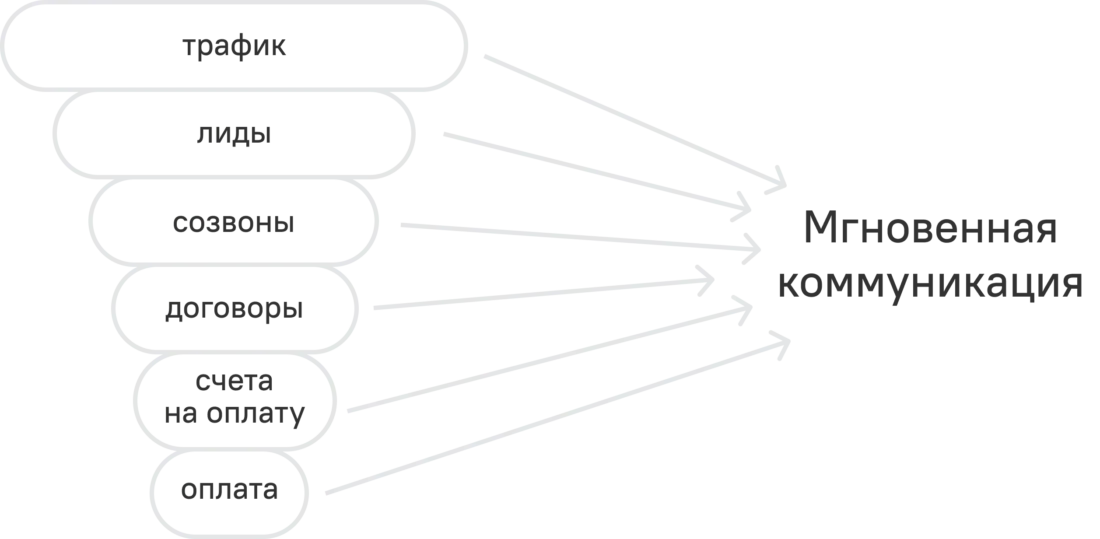
The sales funnel is the movement of a customer from getting to know a company to making a purchase.
Usually a sales funnel is built for marketing and sales. In it, teams spell out the steps that each team is responsible for: attracting traffic to the site, collecting leads, making calls, signing contracts, and making payments. Each step has a success metric attached to it, and if something goes wrong in the funnel, teams analyze it and revise their strategy.
Companies now build a sales funnel around the customer to make it easier and faster to move toward a purchase. Marketing and sales teams build their strategies around communication with the customer. The main goal of marketing and sales is not to increase metrics, but to respond and engage with users as quickly as possible.
Where previously a user could wait hours or days for a company to contact them, now companies have to adjust to their customers and respond quickly to requests. Communication is a key process for the sales funnel, and it needs to be organized so that the user gets a quick solution to their problem.
Sales managers often work for the funnel, for the process. It should be the other way around: the company should work for the customer. The funnel is built for the customer, to make it easier for them to solve their problems, not for the company.
Stages of the sales funnel
The stages of the sales funnel are well described by the AIDA model: awareness, interest, desire, action. The AIDA model divides user interactions into stages based on readiness to buy and helps you attract more customers.
The AIDA funnel model is suitable for any type of business, but the stages of the funnel depend on the specifics of the business. The funnel consists of four stages:
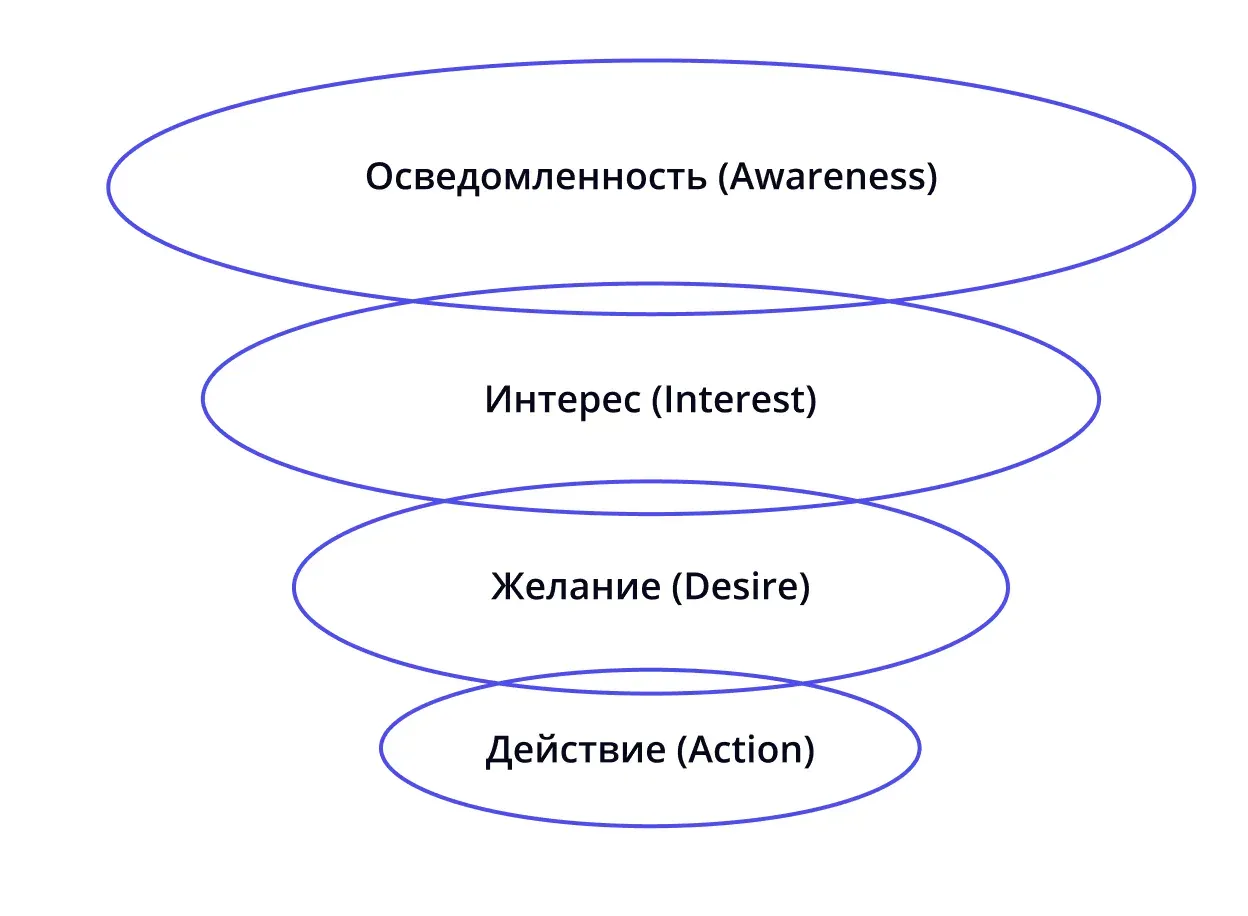
Awareness. At the first stage of the sales funnel the user learns about the existence of your company.
Interest. The user is interested in the offer: browsing the catalog, studying delivery terms, payment methods and other details.
Desire. The user adds the product to the cart and wants to buy it.
Action. The user takes action: places an order, subscribes to a mailing list or calls the contact number.
This model is similar to a funnel, as the number of people decreases at each stage.
If too many visitors leave at one stage of the funnel, you need to check if everything is okay there. Chances are that users aren't getting a quick response from you: they encounter a problem, can't solve it on their own, and leave. It's important to build the funnel so that at each stage users get the information they need instantly.
According to Drift research, customer demand for quick interaction with companies has increased significantly since 2021. 46% of respondents wait no more than 5 seconds for a response from a chatbot on the site, and 43% want to wait the same amount of time for a chat message.
A chatbot will help you quickly respond to user behavior. It will allow you to:
reduce response time to users;
free managers from answering simple questions with a chatbot or
knowledge base, and concentrate on sales;take the load off the call center;
to connect the entire team to the communication with the client;
save money on expanding the staff of managers.
The sales funnel of each business will look different depending on what stages the user goes through on his way to purchase. The funnels of different online stores or online services will resemble each other, but the details will differ.
Let's break down what funnels look like for online stores, online services, and B2B.
How to work with the sales funnel
Build CJM
In order to better understand the customer journey, to know where and at what step of the funnel to start communicating with the customer, build CJM (Customer journey map) - a map of the user path in the product. The map outlines the user's steps from learning about your company to making a purchase on your site. CJM fits any business: online retailers, as well as companies in the banking industry. It helps speed up the movement of the user through the funnel.
Based on the map you collected, identify the weak points in the funnel: the stages where most of the customers leave. These areas of the funnel should be worked on first.
It's important for marketing and sales teams to build a collaborative CJM so they understand what stage of the funnel each team is working on.
Combine marketing and sales teams
Marketing gathers leads on the site and leads them to sales. Sales calls up those leads and leads to a purchase. If the teams don't work together, few users are likely to get from the first stage of the funnel to the last. And that affects the company's bottom line.
In order for as many bot visitors as possible to eventually become buyers, you need to set up the lead-to-sales stage. To do this, you need to synchronize marketing with sales and set up collaborative processes.
Step 1 - Building a sales funnel together
On the Miro board, you can prescribe the funnel steps that a user must go through on the site, and assign a team responsible for each step. For example:
Marina, a marketer, launches an advertising campaign with the collection of leads on the demo.
The collected base immediately goes to the sales team, where the manager Maxim calls the received leads and qualifies them.
Qualified leads are passed on to sales manager Matvey, who conducts service demonstrations and concludes deals.
Users who are not ready to buy are sent back to marketing to finish warming up.
When everyone on the team understands their area of responsibility, it's easier to find a breakdown in the funnel and fix it.
Step 2 - Creating common rituals
Collaborative processes shouldn't end with building the funnel. Teams need to set up joint hypotheses based on the data collected, discuss the advantages and disadvantages of the current sales funnel, and suggest options for improving it.
Bring marketing and sales together every two weeks to discuss processes. Teams will be able to give feedback on leads, analyze advertising campaigns: which ones are worth scaling and which ones should be turned off.
Step 3 - Establish feedback between teams
When multiple teams are involved in the sales funnel, it's important that each team shares the results of their actions and observations.
The marketing team collected a large base of leads during the advertising campaign and gave them to sales to call in. Sales managers started calling them, but more than 70% of these leads were not valuable to the company: they did not make contact and did not fit the qualification parameters. It turns out that marketing wasted the advertising budget, and sales wasted their time.
If sales doesn't tell marketing about low-quality leads, marketing will continue to deliver contacts of users who won't make a purchase.
Step 4 - Setting up a lead transfer from marketing to sales
One step in bringing teams together is setting up lead transfer processes. It's important for sales to get the base from marketing quickly and start processing it quickly.
Start communicating with users first and qualify them
When a customer has just entered the bot, it's important to start communicating with them quickly. Your first priority is to keep the user in the bot to move on down the funnel.
For the user to stay, they need to understand the value of your product. Find out what kind of pain he came to you with through qualification - the process of evaluating potential customers on their ability, willingness and desire to buy your product or service.
Qualification in the first stages of the funnel will help weed out users who aren't interested in the product and leave those who are most likely to reach a purchase.
Set up a bot that instantly prompts the user to answer a couple of questions. The person doesn't need to talk to anyone or respond to text messages: he just clicks on the button with the right answer option. The user is not annoyed, and you quickly get useful information.
After collecting leads, immediately analyze the base and continue interacting with users
The lead base is collected, now you need to warm it up to push it to the next step of the funnel. Both marketing and sales teams can work at this stage.
What leads are:
MQL (Marketing Qualified Lead) - A customer with a potential need for a company's product or service. These are the leads that marketing has qualified. When MQLs get into the CRM system, the sales manager contacts them to confirm the data, find out the problem and propose a suitable solution.
Leads that didn't qualify are sent to the self-service funnel to warm up and figure out the service themselves without our help. We send letters to such clients with useful materials and bonuses, set up a consulting chat-bot on the website, but do not call them personally.
SQL (Sales Qualified Lead) - a lead qualified by the sales team, or a customer with a proven need and readiness to buy. These are users who meet the criteria of a "valuable" lead. The sales team works with such leads: they call them and select personal solutions.
Help the user get to the point of purchase
The marketer has warmed up the lead with communications, and the sales manager has discussed all the details with the customer and gotten to the deal. Next, in the ideal scenario, the sale happens. At this stage of the funnel, you also need to react quickly: the visitor may put items in the cart and not place an order, start paying for a subscription and not complete it.
To get the user to the payment stage, you need to motivate him additionally with the help of chatbots. If he starts subscribing but doesn't get to the end, a chat bot can be set up to help him get through the other stages.
Don't leave the user after a purchase
If the person has made a purchase, then you have reached your goal. Don't stop there, it's important not to lose contact with the client, because it's much cheaper to keep current users than to attract new ones. Mailing lists with bonuses, useful materials, and so on will help with this.
Constant interaction with the client builds loyalty to the product and increases the likelihood that they will make a repeat purchase, subscribe more expensively, or activate additional features in the service.
Common mistakes when working with the sales funnel
Waiting for the user to write himself.
Not synchronizing marketing and sales teams.
Not knowing your target audience.
Not promoting the user through the funnel.
Building the funnel from a template.
Taking all the leads collected on the site into work.
Avoid communicating with users.
Как улучшить воронку продаж?
Объедините маркетинг и продажи. Командам важно иметь общие цели и знать, как они взаимодействуют с клиентом на своих этапах воронки. Мы рассказали о нашем опыте объединения продаж и маркетинга.
Квалифицируйте лидов. На начальном этапе общения с пользователем узнайте всю необходимую вам информацию, чтобы к продажам поступили почти готовые к покупке клиенты.
Передавайте в продажи только целевых лидов. Не стоит слепо собирать базу и всю ее выливать на отдел продаж. Сэкономьте время обеих команд и определитесь, кому вы хотите продавать. А затем придумайте критерии, которые будут помогать вам определять целевых лидов. Это поможет отсеивать незаинтересованных пользователей.