In 2022, everyone rushed en masse to conquer Telegram - it became a key social network, but at the same time it remained a messenger. Although it has borrowed the features of social networks, it is not like the rest - there is no algorithmic feed, the business is limited in its promotion methods. And with the subscriber has to interact differently, because in fact you are constantly writing to him in the "personal".
We decided to look into these peculiarities.
What do we have?
1. Most people subscribe by recommendation. For example, when a link/seed/feedback is posted on a channel that a person has been following for a long time. This mechanism implies that the person trusts the source who recommends the channel.
2. Telegram is more expensive than other social networks for loss of reputation, precisely because the majority of subscriptions to a resource occur on someone else's advice. It is difficult to regain credibility if the user has already unsubscribed from a channel or bot (and Telegram's promotion tools are still limited). The older the sphere, the more critical the frustration of subscribers with the content.
3. Therefore it is necessary to put a special emphasis on the development of word of mouth. Objective 1 - to make sure that you are recommended. You can achieve this through quality content and consistent promotion.
4. People in Telegram have high demands for content, and the opportunities to attract attention to it are very modest. There is no way to cheat - a picture does not catch on, a clever feed does not pull it out. So analyze your content regularly.
What should you pay special attention to? First, deep declines and periods of high unsubscribes. They signal that you're systemically doing something wrong with content or promotion. Second, average engagement. High ER scores indicate a highly engaged audience and their interest in what's going on.
5. Collaborations and seeding have great potential for promotion. Simply because, at their best, both are perceived as recommendations. It's easy to lose as well as gain coveted "reputation points" in native advertising. So you yourself do not fit into the dubious advertising and do not let the same dubious ones on your resource. Carefully ensure that your promotion promises exactly the content that you have. A large number of advertising publications in a row - also a bad idea, it can give the impression of "the channel rolled, I have to unsubscribe".
6. In Telegram, there is an effect of deferral: channels read and view content "in batches", often much later than the publication. In analytics, it is important to take this point into account.
For example, if you have a task to analyze the posts from December 1-30, start the task around the 10th: let the last posts "infuse". It's very likely that by the first of the next month, not all of the core CA will have had time to look at the content.
85% sign on recommendation
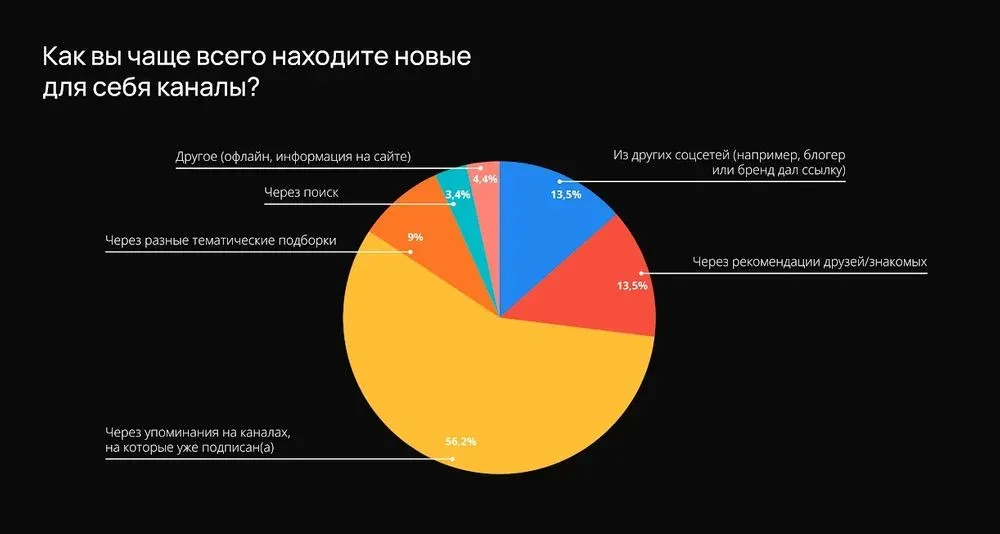
The key source of traffic to Telegram is good old-fashioned word of mouth. The vast majority do not search for resources on their own:
57% of respondents follow the recommendations of those to whom they are already subscribed;
13.5% responded that they follow the recommendations of friends and acquaintances;
another 13.5% subscribe to resources that have been recommended to them on other social networks.
The most popular responses imply that the person trusts the source that recommends the bot or channel. Or at least generally knows the source making the recommendation.
The most unpopular response options are the most impersonal; they do not have a specific recommendation from a specific person/blog/company behind them:
moderately infrequent subscribers come from topical picks - 9%;
only 3% of respondents specifically search for resources via Telegram search.
That is why it is extremely important to form a trusting relationship with your audience in Telegram. Especially if you want to monetize the resource in the long term. The higher the trust, the steeper the indicators of the ads you sell. And since the numbers are cool, they will come back to you again and again.
83% check at least 5 posts before subscribing
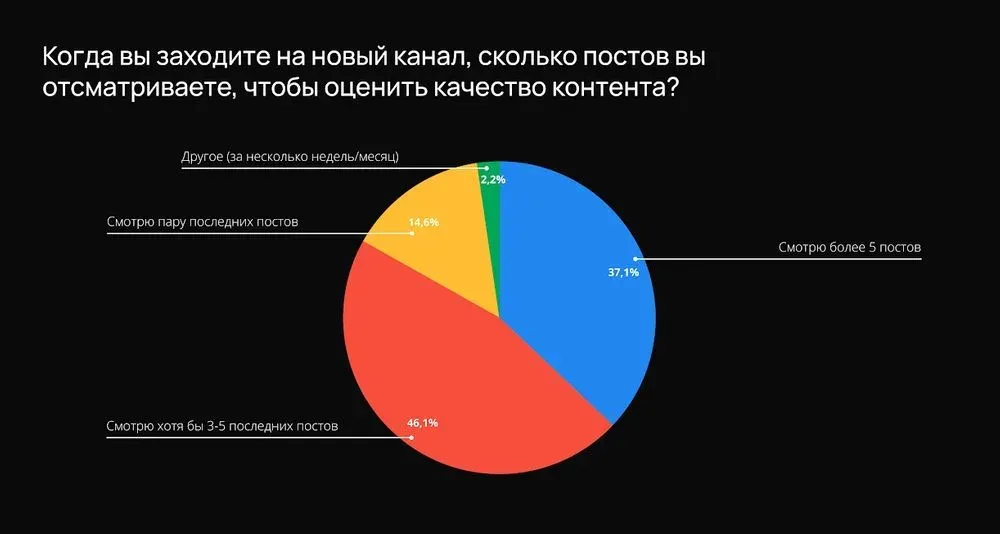
Telegram is perceived as a private space. No one likes to receive spam in private messages, so before subscribing, users look at the publications in it.
And, as the survey shows, they do so quite meticulously:
46% look at least 3-5 recent posts;
37% look at least 5 posts;
only 14% just need to look at a couple of recent posts.
Why does this distribution of numbers suggest pickiness? Because scrolling through content on Telegram is far less convenient than on any other social network:
There's no overall view, like you can't, like you can't on Notgram - you can't just superficially run through the headlines and see if there's any nonsense or savagery from the authors.
There is no abbreviated view of the post, as, for example, in VKontakte with its "View in full. That is, all posts have to be viewed in their entirety: longreads, picks, videos, and short jokes are all mixed together.
Perhaps the interface is partly responsible for the high value of recommendations. People just hope that the recommender has done all that work with checking the content for them (but of course, that's not certain).
In general, the moderate pickiness may be due to the fact that people don't want to clutter up their personal space. The fact is that there is no smart feed on Telegram. The user has to make an active effort to see the most interesting and relevant content to which he himself has subscribed. It makes sense that before subscribing, people also make an active effort to rate - so that they don't have to dig through the "trash" for a gem later.
68.5% mute immediately after signing up
A feature in Telegram that deserves special attention is the disabling of notifications. How quickly are channels sent to "silent mode" and how often do people check channels that they themselves have muted?
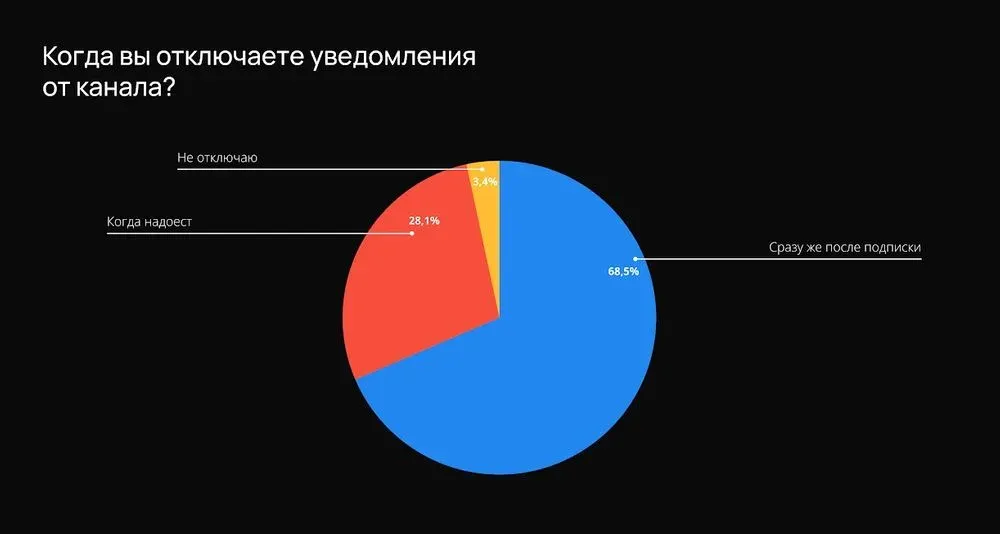
Courage. No matter how great your resource is, sooner or later you'll get shut down:
68.5 percent will be turned off as soon as they sign up;
another 28% will be sent to kill you when they get bored with the channel;
and only 3.5% will receive notifications from you.
This is exactly what we talked about in the previous block: in order to read your content, the user will have to put quite a lot of effort-perhaps going through dozens of other locked channels, going through everything that has accumulated. Sometimes the count goes into the thousands of posts.
Under such conditions, we talk about high quality content. A person always wants his efforts to pay off. If he plunges into a sea of muckraking channels, it is certainly not for the sake of mediocre content, which is not really needed at all.
So, let's take it as an axiom: most people mute your channels, and most people need to make an effort to see your content. How often are people willing to check out channels that have disabled notifications?
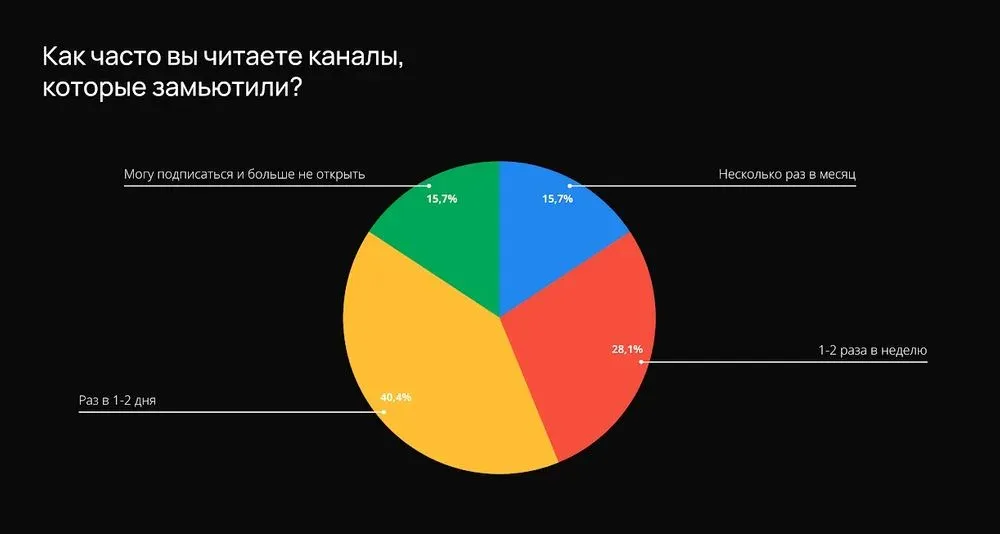
40% open their mouth once every 1-2 days;
28% check the channels a couple of times a week;
15% chose "Several times a month";
another 15% (!) admitted that they might subscribe and never open a channel again.
We assume that coverage in Telegram is accumulated over several days. Our personal experience of running a channel confirms this: only 30% of views appear in the first hour after publication. The rest can "drip" for at least several hours and even days. This leads to two key conclusions about content in Telegram:
Priority is given to content with a medium shelf life. Unless you're a news resource, of course. There everything is clear: lightning, sensationalism, breaking news, always comes first. At the same time, remember: no social network enjoys success with stale and irrelevant content. So, everyone else (not newsmen) needs to look for the golden mean - topics that will be relevant not only today, but also in a couple of days.
Urgent announcements will only be seen by fans. If you throw in a link to some action or event, you should throw it in with a reserve. This way you'll reach far more people than if you announce something on a day to day basis.
Another crucial point about analytics: if you're evaluating content results strictly within a calendar month, you run the risk of underestimating the most extreme posts that came out last. Simply because they haven't had time to get all the juice (all the views) yet.
60% do not purposely purge their subscriptions
Another effort a Telegram user makes is to courageously open the list of resources and delete those he no longer wants to read:
27% clean up once every few months;
13.5% clean up once or twice a month;
only 5% don't delete anything at all.
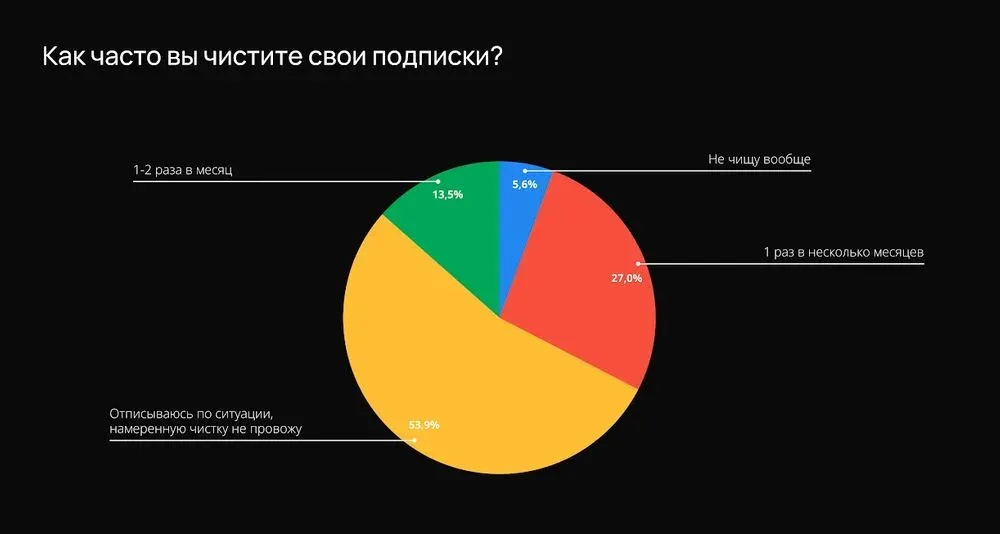
And where are the majority, you ask? And the majority are reporting back on the situation. 54% do not purposely purge. We'll come back to these guys later, but for now, let's deal with the minority.
That very solid 40% of cleaners and the 5% who don't clean tells us that the quality of content can also be judged after a while. If you post something wrong, you won't even know it right away by the number of views - they may not drop. Another thing is that they can give you feedback with reactions and comments.
An important point: remember that users evaluate the usefulness of a channel based on several posts at once? Sustained average content will be noticeable, and it's a good reason to unsubscribe.
The paradox of Telegram: despite the fact that a bunch of content subscribes people, you only need to screw up once to unsubscribe. More precisely, you need to screw up so that the 54% who unsubscribe for the situation pay attention to your content, visit your channel, and... get out of there.
Over 50% unsubscribe due to irrelevant content
And this is where there are no surprises, here Telegram behaves like any other social network. The main motivation for unsubscribing is uninteresting, irrelevant and irrelevant content. More than 50% cited this as the main reason for leaving the channel.
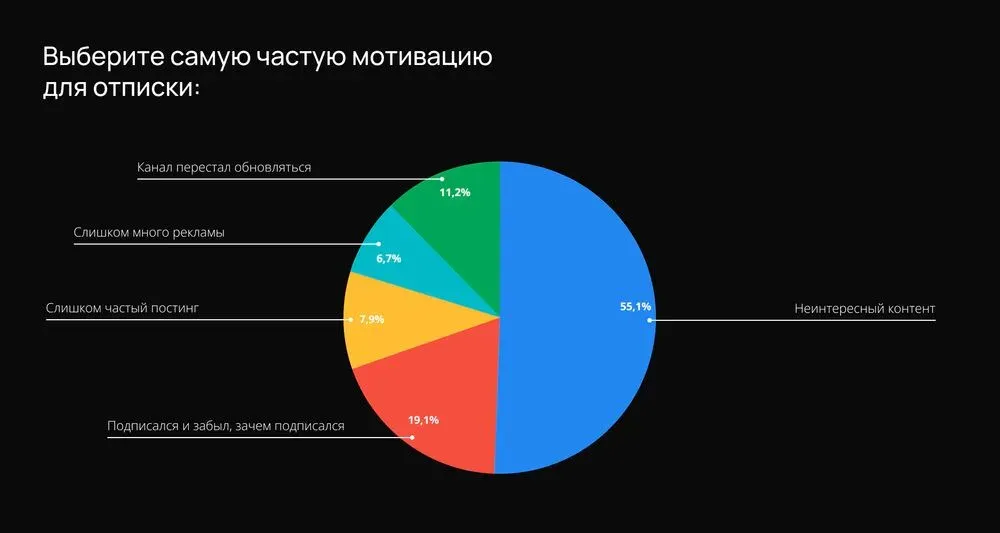
Other reasons included:
stoppage of posting - the channel stopped being updated;
too frequent posting;
too much advertising.
The most curious point: 19% responded that they often unsubscribe because they could not remember why they signed up in the first place. So in addition to the obvious "make good content and don't make bad content," there is another point.
Reading TG posts is an active action. And it should be encouraged and paid for time after time. Be careful with clickbait titles-yes, you'll lure people to your channel, but if the title doesn't match the content, you'll only be wasting someone's time. In an age of information overload, this is tantamount to a crime against the user.
In general, Telegram is governed by the same laws as other social networks: good content gets a "Like", bad content gets a "Reject". The differences are in the details, and they are quite critical: the deferral of coverage, the reading of closed channels, the high value of recommendations - all this creates the specificity of content in Telegram.