The ChatGPT neural network, an artificial intelligence-based chatbot that was unveiled in late November last year, literally exploded the world. In just a couple of months, the number of active ChatGPT users reached 100 million.
There are already cases where "artificial intelligence" has written medical reports and court verdicts, not to mention "harmless" school homework and student essays. ChatGPT can write texts, create pictures and videos, work instead of IT people (for example, produce program codes). And not only those who want to transfer some of their work to artificial intelligence, but businesses are already interested in it.
After all, if a chatbot can work instead of specialists, why keep extra people on the staff and pay them a salary?
How to sign up for ChatGPT
And there is a pitfall - ChatGPT in Russia is not blocked, there is access to the site, but to register, alas, will not:
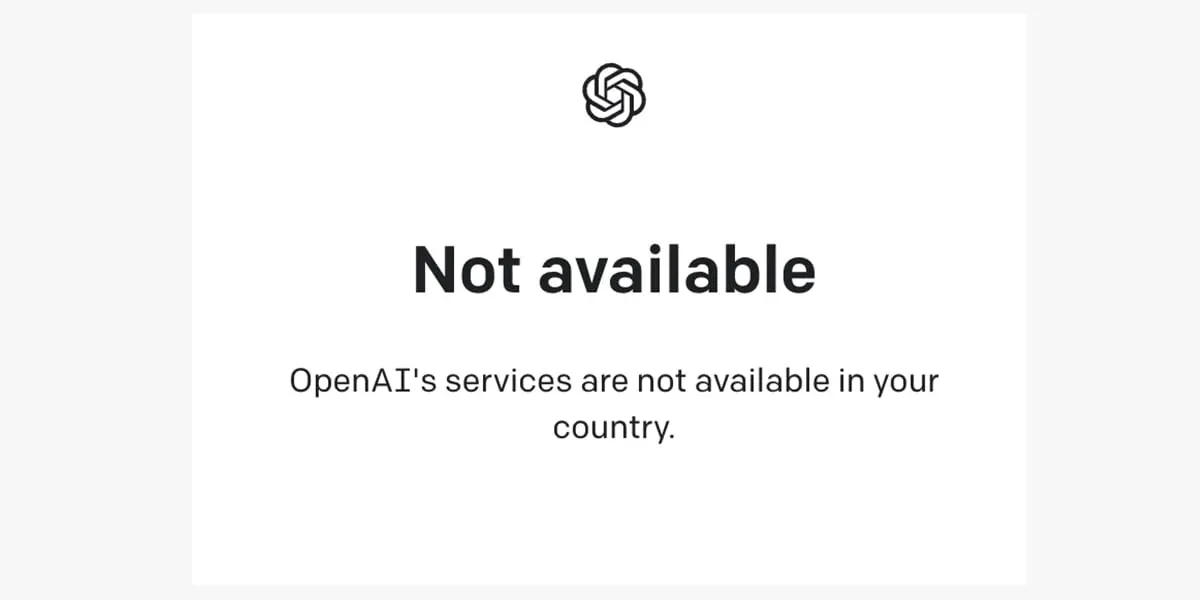
Okay. Use VPN. After logging in through the VPN, you need to enter your email and come up with a password. You will receive an email to confirm it. Follow the link, and then the most interesting thing - you have to specify your phone number. Of course, the Russian does not work either.
At the step of entering the number, go to sms-activate, choose in the left column service OpenAI:
Go to any site receiving sms, buy such a number, put it into ChatGPT, waiting for the code and enter it. Price of a question, for example, for a site 5sim.biz - 12.5 rubles. Yay, we're in!
Что такое ChatGPT и что он умеет?
The ChatGPT neural network was introduced by OpenAl on November 30, 2022. And literally in a couple of months it gathered 100 million users - a result that popular social networks, like, say, Negram, had to go to for more than two years.
ChatGPT - a chatbot, which can ask questions in a dialogue. And the uniqueness of the development is that a neural network can even understand what the person has in mind when asking a question. And, accordingly, it answers as a person. At the direction of the interlocutor, the chat-bot can perform tasks, analyzing large amounts of information. You just need to say what you need, and the artificial intelligence will offer a solution.
GPT-3, which is used in ChatGPT, has 175 billion parameters and was trained on 570 gigabytes of texts. For comparison, its predecessor GPT-2 had 1.5 billion parameters. That is, developers are improving the artificial intelligence, making it more and more advanced and "human. Also, the range of tasks that can be solved by artificial intelligence is expanding: by giving competent instructions, a person can teach a chat-bot and eventually get the product that he needs. And the "smarter" the request, the better the neural network response.
However, so far, everything is not so smooth: the artificial intelligence often makes mistakes. The main problem is that while the answers ChatGPT produces are often wrong, they usually look like they can be right.
What can ChatGPT do? At the request of the user chat-bot can not only give answers to questions posed, but also to write an essay, a book, a poem, create an illustration, a melody, a computer code, etc. That is a smart neuronet can take over a part of your robot. And if you train it additionally (say, offer some of your personal works), then the artificial intelligence will even do everything in your style - so that no one will suspect a trick.
From student essays to books and computer programs to just chatting
Not surprisingly, ChatGPT is increasingly being experimented with, from schoolchildren and students for whom artificial intelligence writes homework and essays, to professionals and businesses.
For example, in Colombia, a judge used ChatGPT to make a court ruling. As The Guardian reported, judge Juan Manuel Pedilla Garcia used artificial intelligence to decide on health insurance - whether it should cover the entire cost of treating an autistic child.
The experimental judge said that ChatGPT wasn't the only one making the decision. He himself was guided by the precedents of similar cases, and the artificial intelligence only helped him work faster. However, in Colombian legal circles, the very fact of involving artificial intelligence in the verdict caused quite a stir.
Active use of ChatGPT in the creative fields
For example, food designer Ammar Reshi wrote a children's book with the help of ChatGPT, created illustrations for it, and is now selling the novelty on Amazon.
ChatGPT also wrote music in the style of rapper Drake, and by adding a voice synthesis tool Uberduck experimenters even managed to get a finished song. Experts say that now your own songs can create almost any user of the Internet.
Media giant BuzzFeed went even further: in its internal memorandum said that it plans to use artificial intelligence to create content. The company has already signed a contract with Meta and will work with the developer ChatGPT to use the capabilities of a neural network. On the back of this news, BuzzFee's stock soared 150%.
And these are just some of the examples.
Can write texts better than 90% of copywriters
A smart neural network that can write lyrics, music and computer codes just as well as a person has activated the talk that a big change is coming to the labor market and that humans will be replaced by artificial intelligence. The representatives of some creative professions such as copywriters and journalists, for which texts can be written by ChatGPT, should be worried. And if not for free for the employer, it is much cheaper than for authors.
In a few years, ChatGPT or its analogues will write typical marketing texts better than 90% of copywriters, and the job of the top 10% of copywriters will be to choose which of the suggested options best fits the company's goals.
The same goes for designers (there is already a specialized version of artificial intelligence on design) and IT coders.
Recruiters say that AI may indeed become a competitor for mid-level professionals, but it is unlikely to replace top professionals in the foreseeable future.
However, it is clear that all stars in the profession obviously will not become stars. That is why recruiters predict a shift in priorities on the labor market, and accordingly, in professional education. Specialties in which it is still difficult to replace a living person by a machine will become more and more popular, for example, medicine, services, etc.
At the World Economic Forum it was forecasted that 85 million jobs will simply disappear because of automation. But at the same time, 97 million new jobs will appear. Some jobs will disappear, others will appear. Artificial Intelligence will completely change the way we work over time, and employers will hire specialists who can integrate new technologies into their work. This will affect the labor market and education.
Algorithm of the request:
Define the ChatGPT role. This can be done with a sentence like "I want you to act as a very experienced bot developer."
Motivate the ChatGPT. For example, for an SEO-related task, you could write, "I want you to imagine that you can write such a good structure that it can outperform other bots."
Clearly state the task and spell out the order in which it needs to be completed.
Give context. Explain to ChatGPT who your target audience is and what goal you want to achieve.
Specify your writing style: formal / informal / professional / technical / creative / conversational / humorous / serious, etc.
Write in what form the answer should be presented. For example, "break the result into paragraphs, it should be quick and easy to read"; "form it as a bulleted/numbered list," etc. You can also give an example in the query: "| Column 1 | Column 2 | Column 3 |" - then the result will be presented as a table.
Testing:
Request:
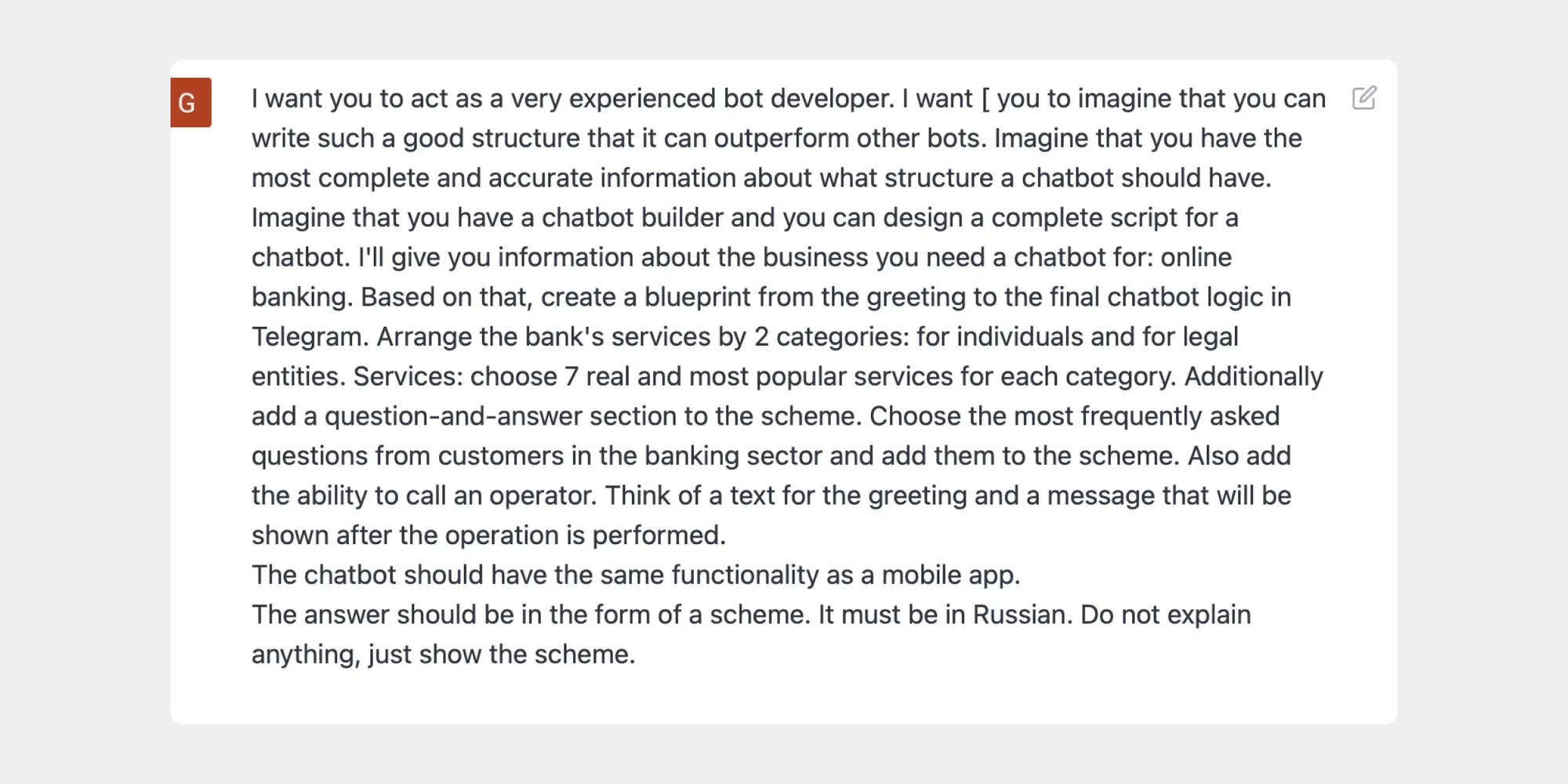
Result: