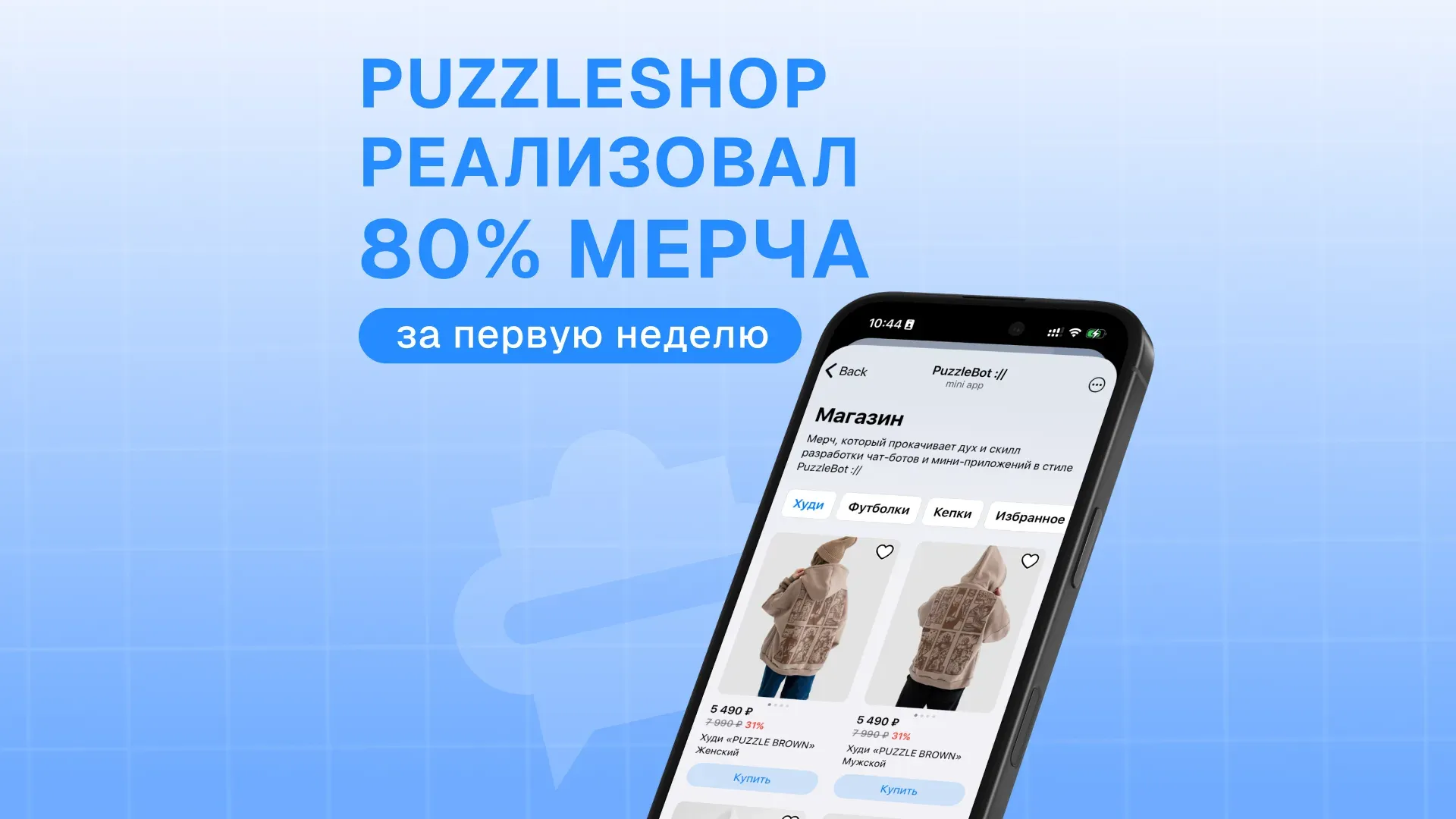
We decided to make puzzlebot merch available to everyone! It was originally a gift for the team and members of our private club, but the start of production coincided with an update to our store in the mini app. Now anyone can order items and check out the new store interface.
The challenge
Before the launch, the goal wasn't to create a separate clothing store and promote it as a standalone business. The task was different:
give users a nice bonus, namely the chance to buy merch.
demonstrate the updated store functionality in the mini app.
show that the Store section can be launched by one person, without bringing in designers or developers.
What was done
The store wasn't added as a separate app but as another tab inside the existing mini app. The team only needed the store's no-code functionality: the same interface that's available to any user of the platform.
The store includes:
a catalog broken down by clothing category
a description and size chart for each item
prices, discounts, and built-in promo codes
delivery checkout
The user journey is fully optimized based on marketing research into consumer behavior. The built-in functionality covers every stage from browsing the catalog to placing an order, and all that's required on your side is minimal setup: uploading photos and filling in descriptions (by the way, we have a detailed lesson on how to do this)
Launch resources: just one person from the team.
Launch time: to start with a small number of items, you can put the store together in a few hours. A larger range will take more time to upload the product cards. So that you don't have to use third-party services, we've made it possible to connect payment systems right in the Constructor. Just keep in mind that approval on the payment system's side may take some time — we recommend factoring this into your launch plan.

App demo
When users open the mini app, they see several sections: about the service, learning, and the Store tab. Inside it, the user journey feels familiar and intuitive, just like in any modern online store:
choosing a product category.
a product card with photos, a description, and a size chart.
applying a discount or promo code.
arranging delivery and paying.
The team didn't do any additional code customization; the entire user journey is already built into the standard store template.
Results
The store was launched as an extra way to buy merch and, at the same time, as a way to test puzzlebot's updated functionality on our own project. The results showed that even such a quick launch can serve a real commercial purpose:
Sales — 80% of the merch run sold in the first week after launch
Time savings — launching a full-fledged store took hours, not weeks of back-and-forth with a designer and developer
Budget savings — no need to budget for marketplace fees
A ready-made user journey and design — business owners don't need to work out the catalog and checkout logic themselves; it's already done for them.
Direct access to your audience in Telegram — unlike on a marketplace or in an email newsletter, users are very likely to see messages from the brand, which makes it easier to collect contacts, segment your audience, run promotions and promo codes, and build brand loyalty overall.
While everyone watches revenue, conversion, and order volume, experienced players look at other metrics too. If you need to test a hypothesis quickly or cut spending on external services, the key metrics are time, money invested, and launch resources. Our experience confirms it: one person can build a store in a single day, because the entire user journey is ready to go.